Does Sex Sell? Advertising’s Favorite Shortcut Keeps Working, Even When It Shouldn’t
Updated: Jul 22
The Banana Problem.
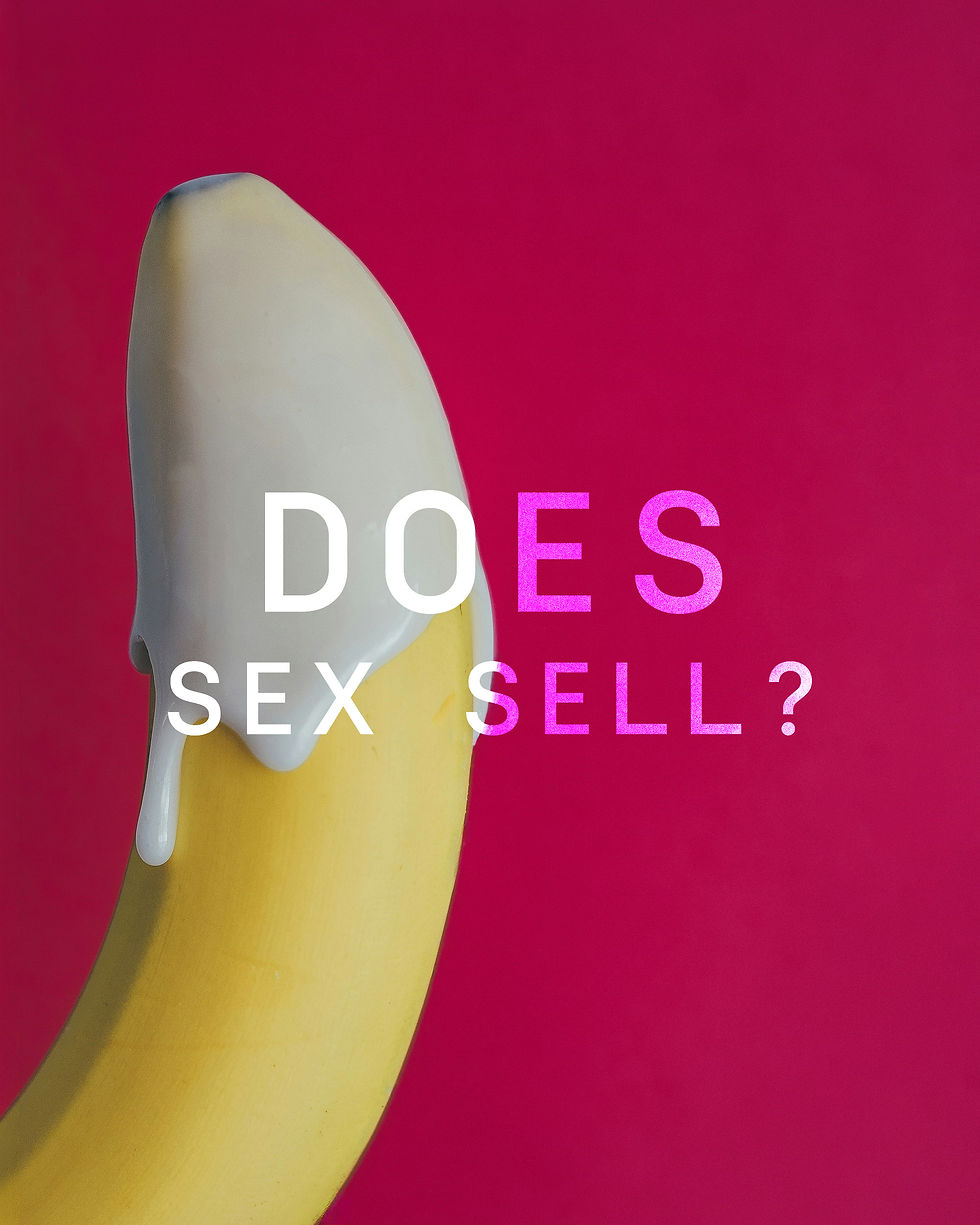
A banana dripping in white icing appears on a screen for less than two seconds.
You look anyway.
That reflex is the entire business model behind a massive portion of modern advertising.
WHY THE BRAIN LOOKS?
For decades, marketers have used sexuality as a psychological crowbar, a fast way into human attention. Sometimes elegant. Sometimes subtle. Sometimes about as restrained as a bachelor party in Las Vegas.
The formula survives because it taps into something older than marketing itself.
Human beings are built to notice signals connected to attraction, status, beauty, intimacy, and social value. Long before algorithms and media buyers existed, the brain learned to prioritize those cues automatically.
SEX IS NOT THE PRODUCT.
Advertising figured this out early.
A perfume campaign rarely discusses perfume.
A luxury car commercial almost never talks about horsepower for more than a few seconds.
Fitness brands often sell confidence and results before they sell fitness.
The product becomes secondary to the emotional atmosphere surrounding it.
PEOPLE BUY ASSOCIATIONS.
Consumers rarely buy objects in isolation. They buy associations.
A Rolex can represent status.
A Montblanc pen can suggest success.
A Harley-Davidson motorcycle can imply rebellion without requiring the owner to overthrow a government.
Marketing, at its best, functions less like information and more like symbolic storytelling.
Sexual imagery simply happens to be one of the fastest ways to inject emotional charge into a message.
ATTENTION IS NOT PERSUASION.
The problem is that attention and persuasion are not the same thing.
Research has repeatedly shown that sexually provocative advertising increases ad recall more reliably than brand recall.
People remember the image. The company fades into the wallpaper.
Entire campaigns disappear into a blur of “I think it was for cologne?” while millions of dollars quietly evaporate in the background.
WHEN THE CREATIVE STEAL THE SHOW.
That creates one of advertising’s strangest paradoxes: the creative can become more famous than the thing it was hired to sell.
Fashion and fragrance brands manage this tension better because attraction already belongs to the category. Desire feels native there.
A sensual campaign for a luxury perfume does not create cognitive friction because the audience expects fantasy in the transaction.
A fast-food chain trying to market hamburgers like a late-night cable movie tends to produce a different effect entirely.
AUDIENCES GOT SMARTER.
Consumers have become unusually skilled at detecting forced seduction in advertising.
Years of internet exposure sharpened that instinct.
Audiences now scroll through enough visual stimulation before lunch to make early-2000s magazine ads look almost quaint.
Shock value lost much of its monopoly.
DESIRE IS BIGGER THAN SEX.
That shift explains why many modern campaigns lean toward humor, authenticity, documentary-style storytelling, founder narratives, or creator-driven content.
These approaches feel emotionally closer to real life. They produce recognition rather than spectacle.
People still respond to desire. That has not changed.
The definition of desire simply expanded.
A person may want status, belonging, confidence, transformation, momentum, reassurance, exclusivity, freedom, recognition, or identity reinforcement.
Some brands understand this deeply enough to sell aspiration without relying on provocation at all.
THE BEST CAMPAIGNS FEEL DELIBERATE.
The strongest campaigns rarely feel desperate for attention.
They feel culturally aware. Comfortable in their own skin. Slightly dangerous, perhaps, but deliberate.
That distinction matters.
When sexuality supports the emotional logic of a brand, it can amplify memorability and emotional intensity.
When it exists only to trigger reaction, audiences often sense the emptiness immediately.
The campaign becomes visual caffeine: stimulating for a moment, forgettable by evening.
THE LESSON.
Advertising history is filled with beautiful campaigns that generated conversation while accomplishing almost nothing commercially.
The industry still confuses visibility with effectiveness more often than it likes to admit.
So, does sex sell?
Sometimes.
But psychology sells far more consistently.
The campaigns that endure usually understand something deeper than attraction itself: people are constantly searching for signals about who they are, who they admire, and who they hope to become.
The product merely joins that conversation.
See you on the track…
Comments